From Local Contest to Shared Ritual: The Rise of the Race Programme
See how a race programme turns a local contest into a shared ritual, helping spectators follow a meeting and preserve the details that made it memorable.
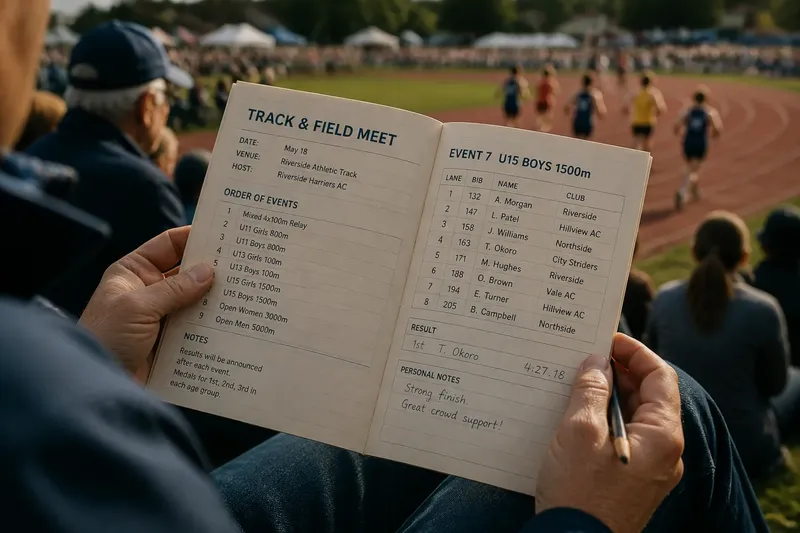
At a small race meeting, a spectator unfolds a race programme beside the course and finds the heat about to start. The names and event order offer a way into the day, even when the runners are unfamiliar and the course bends out of sight.
Names in motion
A list of entrants gives a spectator more than a way to identify the front-runner. It can connect a competitor to a club, school, neighborhood, or division, making an otherwise fleeting figure easier to recognize before and after the race.
That recognition can change what someone watches for. A family member might follow one runner; a club supporter might notice the range of teams on the start line. The programme does not prescribe a reaction. It simply gives attention a name to follow.
A meeting takes shape
Beyond its entrant list, a race programme may include the venue, divisions, event order, and notes about results. Together, these details give the meeting a structure: one event begins, another follows, and spectators can see how the day is arranged.
The sequence also says something about the gathering. A youth race alongside an open event, a club relay, or a community fun run reveals who the meeting welcomes and what kinds of competition it brings together. Those choices give a local programme a character that a generic announcement cannot convey.
Paper in the crowd
A printed programme is easy to hand from one person to another. A parent can point out a child’s event, a volunteer can direct a newcomer to the next heat, and spectators can consult the sheet without gathering around a results board or sharing a screen.
It also stays close to the action. A spectator may fold a corner at the event they came to see or jot down a result as it is announced. The marks are small, but they tie the printed page to the live day.
Imagine a spectator arrives at a neighborhood track meet with a programme listing several heats and entrants. She circles her friend’s name, follows the order on the page, and writes the announced result beside it. The sheet has not changed the race; it has given her a record of the part she watched.
Details worth keeping
After the finish, a programme can preserve the meeting’s name, venue, entrants, and arrangement. Handwritten notes may add a result or a personal reminder, while the paper itself can bring back where someone stood or whom they came to cheer.
It is not a substitute for an official archive. A programme may be revised on the day, omit late changes, or contain no results at all. Its value is often more intimate: it keeps the small details of one gathering that a formal record may not capture.
Print and shared ritual
At recurring meets, spectators may arrive, check the programme, find their place, and turn to the next event as the day proceeds. These repeated gestures give the meeting a familiar rhythm, even for people who attend for different reasons.
Design helps make that rhythm welcoming. A clear title, club emblem, readable type, and open spacing can make the sheet feel like part of the occasion while helping newcomers find their way. Explanations of unfamiliar divisions or result conventions are useful when they fit without crowding the page.
What should a race programme include?
Which details help a newcomer?
A newcomer benefits from the event order, venue information, divisions, and a brief explanation of unfamiliar terms. Entrant or team names help spectators follow particular competitors without needing prior knowledge of the clubs.
Why keep an old programme?
An old programme can preserve the participants and arrangement of a particular meeting. Folds and handwritten notes may add personal memories, though they should not be mistaken for a complete official record.
Can a digital schedule replace print?
A digital schedule can be revised quickly when events change, while a printed sheet is easy to pass around and keep. Organizers may choose either format or use both, depending on the meeting and its audience.
The page and its gaps
A programme is an edited account, not a complete picture of the race. Its divisions and entrant lists reflect what organizers chose to include; abbreviations, late changes, and informal traditions may remain outside the printed frame.
That selectivity is part of its historical interest. A sheet can show how a meeting presented itself, while its omissions remind later readers that the event was livelier and less orderly than the page suggests. A pronunciation note or a short explanation of how results work can make future programmes more welcoming without trying to record everything.
The rise of the race programme rests on its modest usefulness: it connects spectators with a meeting as it unfolds, then carries a trace of that gathering away from the course. Keep one if it holds a detail you want to remember; its creases and notes may tell a story the schedule alone cannot.